The new version of the Association for Project Management Project Management Qualification (APM PMQ) based on the 7th Edition of the Body of Knowledge introduced some new negotiation concepts. These are Zone of Possible Agreement (ZOPA), Best Alternative to a Negotiated Agreement (BATNA) and Win-Win. In this blog post, we briefly explain these terms and their relevance to project management and the APM PMQ exam.
When it comes to project management, negotiation is a core competency that everyone needs to master. Research from World Commerce and Contracting (WorldCC), formerly International Association for Contract and Commercial Management (IACCM), shows that on average poor negotiation and contract management account for over 9% of all project value leakage. As projects become more and more complex and stakeholder groups become increasingly more diverse, structured negotiation approaches such as ZOPA and BATNA are increasingly becoming an essential option that project managers need to be considering.
Where do these terms come from?
These three terms come from the seminal book on negotiations Fisher, Roger, and William Ury. Getting to Yes: Negotiating Agreement Without Giving In, 3rd ed. New York, NY: Penguin Books, 2011. You can read a summary of this book here: Summary of “Getting to Yes: Negotiating Agreement Without Giving In” Beyond Intractability. Still, I strongly recommend reading the full text; it’s a concise but informative book.
Since it was first published in 1981, “Getting to Yes” has sold over 15 million copies worldwide and has been translated into 35 different languages. It is widely regarded as the foundation of modern negotiation theory. It is used extensively in business schools, law programmes, and also on leadership training programs worldwide. The Harvard Negotiation Project, which the authors, Fisher and Ury, helped to establish, still continues to influence both negotiation research and practice today.
The book’s main theme is about understanding what each party wants from the negotiation and then negotiating around the issues, not the people and emotion. In summary, they discuss:
- Separate the people from the problem.
- Focus on interests, not positions.
- Learn to manage emotions.
- Express appreciation.
- Put a positive spin on your message.
- Escape the cycle of action and reaction.
These principles are particularly relevant when it comes to those project environments where relationships play an important role. According to PMI’s Pulse of the Profession report, 40% of all project failures can be linked to poor stakeholder engagement. If you want to help maintain trust, reduce conflict, and also help to create alignment then effective negotiation is essential because all of these elements are absolutely essential for project success.
Three terms are introduced, almost in passing, are ZOPA, BATNA and Win-Win and these have been co-opted into the syllabus for the APM PMQ. In this post, we explain these three terms, without explaining the whole book.
ZOPA
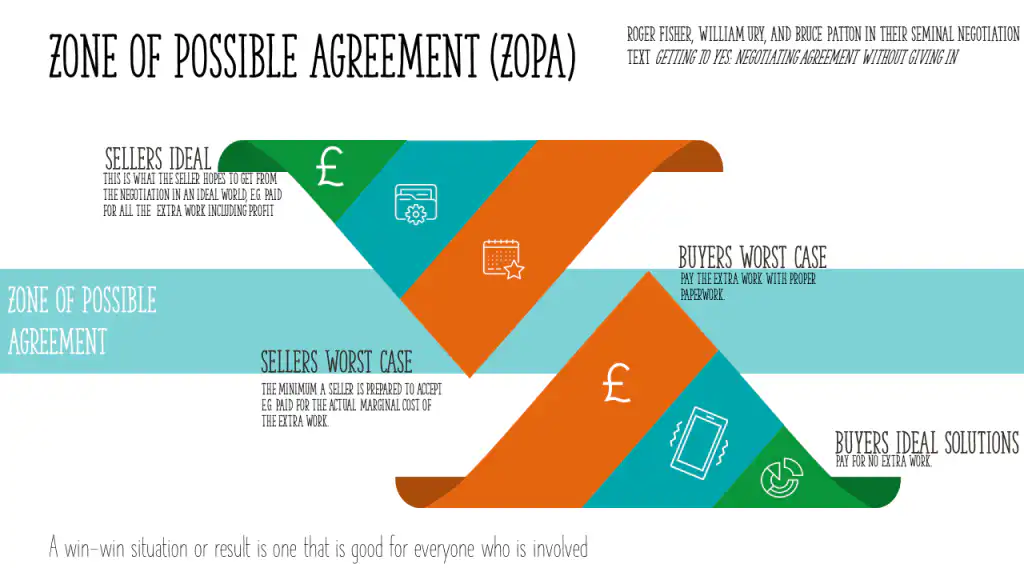
The possible agreement zone represents the overlap between what the seller and buyer are willing to accept. Each will have a best-case and a worst-case outcome from the negotiation. The region in which they overlap is the zone of possible agreement
ZOPA is one of the most practical tools that any project managers could have in their arsenal. This is because it can help them frame negotiations in a more realistic manner. Many negotiations fail not because the parties disagree, but because they are never able to determine whether an agreement is even possible or not. Studies show that those negotiators who explicitly map out ZOPA before discussions begin are much more likely to reach a deal that is mutually acceptable to all parties.
Say, for example, negotiating a claim for additional costs with a customer as part of closing out a contract. Let’s say the situation is:
| Sellers Ideal | Ideally, get paid £1m for all the changes and extra work, including profits. |
| Sellers Worst Case | Accept a minimum payment £400k for most of the changes at marginal cost (no profit) |
| Buyers Ideal | Pay not one penny extra, £0 |
| Buyers Worst Case | Pay a maximum for the approved change requests at contractual rates up to £500k. |
Here you can see we have a possible agreement zone between £400k, which is the minimum the seller is willing to accept, and £500k the maximum the buyer is willing to pay.
In practice, what project managers find is that ZOPA is rarely this clear-cut. They often find themselves dealing with information that is incomplete, priorities that are continually shifting, and significant political pressures. This is why it is so important to ensure that all of your preparations are carried out. Skilled negotiators need to gather data, analyse constraints, and also test assumptions before they enter the room. APM PMQ candidates need to be prepared so that they can demonstrate how ZOPA can be used in order to structure discussions, reduce conflict, and avoid any unrealistic expectations.
It will help if you read Getting to Yes to understand ways of reaching agreement without compromising relationships.
Win-Win
By win-win, they mean finding options that provide mutual gain for the different parties. A solution that gives all parties what they want, as far as possible.
Win-win negotiation is an often-misunderstood term. It does not mean simply giving in, splitting the difference, or even making sure that everyone is “happy.” What it actually means is expanding the value that is available so that both sides are able to achieve meaningful outcomes. Research undertaken by the Kellogg School of Management suggests that integrative negotiation, that is the academic term for win-win, can lead to agreements that are longer-lasting as well as higher satisfaction for all of the parties involved.
The way to achieve win-win is to identify what the other party wants, which you can easily offer. In return, ask for something important for you, but easy for the other person to offer. For example:
If we can agree to take on these changes at cost today then we will make the payment in the next 10 days.
We are exchanging something important to us “agreement to the changes” in exchange for something important to the other side. To do this, we need to understand what is important for them and us.
This is an approach that is known as “logrolling”, the trading of concessions that are low cost concessions for gains of a higher value. Skilled negotiators are those who are able to identify multiple issues, rather than just one. This is because the more variables that there are on the table, the easier it is to find those trades that are mutually beneficial. In project management, there is a good chance that this might involve schedule flexibility, payment terms, resource allocation, or even adjustments in scope.
Win-Win compares to lose-lose where each side compromises and feels they have not got what they should have done. Or even worse where one side wins, and the other side loses.
Win-lose outcomes often have the effect of damaging long-term relationships.
In fact, 47% supplier collaborations are reported to fail as a result of adversarial negotiations. This is something that can reduce the desire to collaborate on future projects. For project managers who work in multiyear programmes or in strategic partnerships, it is essential to maintain an appropriate level of goodwill to help future projects.
Win-win may not always be possible, especially for short-term transactions, buying a car or shopping in a supermarket. However, it should be possible to find a solution beneficial to both sides in longer-term contractual arrangements.
When it comes to long-term projects, the benefits of a win-win approach can in fact compound over time. Not only does trust increase, but communication improves, and both parties will find themselves in a position where they will become more willing to share the risks and opportunities associated with the project. This is why collaborative contracting models, for example NEC4 and partnering agreements, place an emphasis on the importance of joint problem solving and shared incentives.
Best Alternative To A Negotiated Agreement (BATNA)

Sometimes the zone for potential agreement gets so small that the seller and buyer cannot reach an agreement. So what do we do now? If the sellers worst-case and buyers worst case don’t overlap, we will not reach an agreement.
BATNA is arguably the strongest concept when it comes to negotiation. It represents your fallback option, that is to say what you will do if you do not reach an agreement. Negotiators who have a strong BATNA will find that they have significantly more leverage. Harvard research suggests that those people with clearly defined BATNAs in place are more likely to achieve better outcomes, with 80% of the success of negotiations being attributed to robust preparation.
Example:
| Sellers Ideal | Ideally, get paid £1m for all the changes and extra work, including profits. |
| Sellers Worst Case | Pay a minimum of £450k for most of the changes at marginal cost (no profit) |
| Buyers Ideal | Pay not one penny extra, £0 |
| Buyers Worst Case | Pay a maximum for the approved change requests at contractual rates up to £400k. |
In this case, we have no overlap between the £450k demanded by the seller and the £400k the buyer is willing to pay. We could spend all day in the room, but this negotiation will not reach an agreement.
Recognising when ZOPA does not exist is considered to be a mark of negotiation maturity. There are many inexperienced negotiators who waste time trying to “force” agreement when it is clear that the numbers simply do not align. BATNA offers clarity and prevents desperation, which is a common cause of poor deals.
This is where we need a fallback plan, a Best Alternative to a Negotiated Agreement (BATNA). Ideally, we agree on this BATNA with Senior Management (and the Sponsor) before we start the negotiation. For example:
If we can’t agree this payment by the end of the week then we will have to take this to formal arbitration.
We should really agree on this BATNA with Senior Management (and the Sponsor) before we enter the negotiation room. Otherwise, we run the risk of being unable to follow through on our plan and having to walk back into the negotiation with a significantly weakened position.
BATNA that is weak or undefined can often lead to “negotiation traps,” this is where one side accepts a poor deal to avoid conflict, delay, or both. In project management, this is something that can lead to budget overruns, scope creep, or even contractual exposure. It is important for APM PMQ candidates to understand that BATNA is not a threat, but rather a strategic safeguard.
It is also important to consider the other party’s BATNA. Skilled negotiators are able to analyse both sides’ alternatives to understand leverage dynamics. For example, if theBATNA of the buyer is to delay the project by six months whilst attempting to source a new supplier, then their willingness to negotiate may increase significantly. Understanding this can help project to craft proposals that align with the other constraints and motivations of the other party.