
Stoicism and Modern Project Management
Project managers often work in environments defined by uncertainty and pressure. According to Bent Flyvbjerg, a leading expert on megaprojects, most projects suffer from cost overruns, schedule delays, or fail altogether. What makes this more troubling is Cobb’s Paradox, which highlights that project failure persists despite our clear understanding of why projects fail and how those failures could be prevented.
Against this backdrop, Stoicism offers a useful lens for modern project leadership. Originating in ancient Greece and later refined by Roman thinkers, Stoicism provides practical principles for navigating difficult environments while maintaining clarity, resilience, and integrity.
What Can an Ancient Philosophy Teach Today’s Project Managers?
At its core, Stoicism encourages focus on what lies within your control: your actions, decisions, and character. External events are acknowledged but not allowed to dictate behaviour. The philosophy is grounded in four key virtues: wisdom, fairness, courage, and self-control. Together, they support clear thinking and steady leadership, particularly when conditions are challenging.
For project managers, Stoicism offers practical tools. It helps maintain composure under pressure, supports rational decision-making, and encourages ethical leadership when outcomes are uncertain.
Let’s explore how some core Stoic principles apply to today’s project environments.
1. The Dichotomy of Control
One of Stoicism’s central ideas is the distinction between what is within your control and what is not. In project management, many factors sit firmly outside your influence. These include geopolitical events, shifting client priorities, technical uncertainty, and organisational change.
What remains within your control is how you respond. Your decisions, communication, and behaviour shape the environment you lead in. Recognising this distinction allows project managers to focus energy where it has the greatest impact.
2. Virtue as the Highest Good
Stoicism teaches that virtue is the highest good. Wisdom, courage, justice, and temperance matter more than external success or failure. Applied to project management, this means prioritising ethical behaviour and long-term value over politics or short-term wins.
Success is no longer measured solely by perfect delivery. Instead, it is defined by acting with integrity, supporting the team, and remaining focused on the project’s intended benefits, even when conditions are difficult.
3. Acceptance of Reality (Amor Fati)
Stoics encourage acceptance of events as they unfold. This mindset, known as amor fati, involves embracing challenges as part of the journey rather than resisting them.
For project managers, this means acknowledging that not all projects will proceed as planned. Cost overruns and delays sometimes need to be managed rather than eliminated. Leadership, in these moments, is about clear communication and realistic expectation-setting. A good outcome may look different from the original promise.
The Wellbeing Benefits of a Stoic Mindset
Beyond delivery outcomes, Stoicism offers clear benefits for mental wellbeing. The pressure of deadlines, stakeholder demands, and constant uncertainty can lead to stress and burnout. Applying the dichotomy of control helps release the mental load associated with worrying about things that cannot be changed.
Focusing on virtues such as courage and resilience also helps separate self-worth from project outcomes. Peace of mind comes from knowing you acted thoughtfully and with integrity, regardless of the final result. This shift in perspective can make a demanding role more sustainable and, ultimately, more fulfilling.
How Can You Become a Stoic Project Manager?
Stoic principles can be translated into daily exercises that help Project Managers stay focused and resilient in the face of challenges. We’ve identified 10 practices that can help you develop your Stoicism as a Project Manager:
Exercise 1: The Dichotomy of Control Exercise
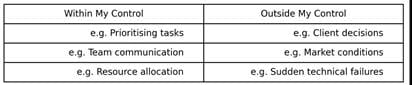
What to Do: At the start of each day, list two columns:
Title the first column “Within My Control” and list actions like prioritising tasks, team communication, and resource allocation.
Title the second column “Outside My Control”: and list external factors like client decisions, market conditions, or sudden technical failures.
Purpose: Keeps your focus on actions that produce results, reducing stress about factors you can’t influence.
Exercise 2: Daily Reflection
What to Do:
Every morning ask yourself, “How will I lead with wisdom and integrity today?”
Every evening reflect on your day using questions like, “What decisions went well? What could I have done better?”
Purpose: Encourages continuous improvement and alignment with leadership values by reflecting on whether you maintained control of your emotions and acted rationally in your decisions and interactions throughout the day.

Exercise 3: Negative Visualisation (Premeditatio Malorum)
What to Do: Imagine potential setbacks, like delays, team conflicts, or scope changes, and prepare your responses calmly. When receiving negative news, focus on understanding the root cause and developing a constructive solution.
Purpose: Prepares you for challenges, reducing emotional reactions and enabling quick problem-solving by targeting the underlying issues and addressing them effectively.

Exercise 4: Practise Amor Fati
What to Do: When unexpected changes occur, reframe them as opportunities for growth. For example, a client’s sudden scope change might be seen as a chance to showcase adaptability. Amor Fati translates to “love of fate” and reminds us to not only accept but embrace all outcomes as necessary parts of the project’s journey.
Purpose: Encourages acceptance and adaptability in navigating project realities while fostering resilience and a positive outlook.

Exercise 5: The View from Above
What to Do: Step back and view the situation from a larger perspective. Ask yourself, “How will this matter in the long run?” Consider how many projects that seemed difficult or problematic at the time are later perceived as highly successful in the fullness of time. For example, Edison’s work on the light bulb or Dyson’s thousands of prototypes illustrate how perseverance and focus on the outcome can redefine challenges as milestones.
Purpose: Helps prioritise decisions, reduce stress over minor issues, and reinforce the importance of staying focused on long-term benefits and outcomes.

Exercise 6: Voluntary Discomfort
What to Do: Tackle challenging tasks or engage with difficult stakeholders proactively. It’s too easy to ignore challenging stakeholders, but they often offer valuable insights that can improve project outcomes.
Purpose: Builds resilience and confidence in managing discomfort, essential for leadership in uncertainty, while ensuring all perspectives are considered for better decision-making.

Exercise 7: Gratitude Practice
What to Do: At the end of each day or week, note three positive aspects of the project, such as team contributions, stakeholder alignment, or progress on milestones. You can involve your project team in this and help share a Stoic approach to project delivery.
Purpose: Maintains morale and shifts focus to constructive outcomes.

Exercise 8: Pause Before Reacting
What to Do: When facing conflict, pause before responding and ask yourself, “What response aligns with the project’s goals?”
Purpose: Ensures rational, constructive communication and de-escalates tensions.

Exercise 9: Memento Mori (Meditation on Mortality)
What to Do: Reflect on the finite nature of the project’s timeline and ask yourself, “What priorities deserve my focus today?” For example, in a project approaching a critical deadline, consider whether allocating resources to troubleshooting a minor delay is more beneficial than focusing on finalising deliverables.
Purpose: Helps focus on high-impact tasks and avoid distractions, ensuring that energy is directed toward actions that will most significantly influence the project’s success.

Exercise 10: Journaling with Stoic Prompts
What to Do: Use prompts like, “How did I handle challenges today?”, “What courageous actions did I take to lead the team?”, “What lessons can I apply tomorrow?”
Purpose: Encourages self-reflection and growth as a leader.

The Stoic mindset equips Project Managers to handle the pressures and uncertainties inherent in their role. By practising these exercises, Project Managers can improve their resilience, focus, and decision-making, ensuring they lead their teams with wisdom and integrity.
As most of our projects exist in uncertain and challenging environments, Project Managers must look beyond traditional tools and should consider embracing Stoic philosophy to thrive in their role. Stoicism offers a timeless framework for navigating challenges, focusing on what you can control, and maintaining composure in adversity.
Combined with structured project management practices, Stoic principles empower leaders to transform setbacks into growth opportunities, inspire their teams, and achieve long-term success, even in a world where uncertainty is constant and failure persists.

Great and timely article Ruth., Despite all the advances in PM theory since the 1960’s, as you mentioned many projects are still delivered late and cost more than estimated so clearly there is still something missing.
‘The pressure of deadlines, stakeholder demands, and constant uncertainty can lead to stress and burnout.’
PM work can be stressful and projects are about people. Stoic theory addresses the people part of PM
Thanks for your comment George. I find Stoicism useful in both supporting people in delivering the project and also managing myself. There is a growing body of research showing that those managers/leaders that embrace uncertainty deliver projects more successfully. The APM actually included this as one of their 8 key skills for project managers as well. It certainly is an interesting subject.